 Accounting Scalable
Incorporation and initial bookkeeping
From freelancer to GmbH: what actually changes?
For self-employed business owners planning or newly incorporating a GmbH or UG.1
Editorially updated on
When does a GmbH or UG suit your business?
A GmbH or UG may suit you if you want to organise your business as a separate company, allow equity participation and retain funds in the company for future investment. Your personal cash needs, ongoing costs and willingness to maintain reliable bookkeeping are decisive. The right legal form follows from this overall picture.12
The practical difference starts before the first customer invoice: the company has its own rights and obligations. Its business transactions belong in separate books with a balance sheet and income statement. Plan incorporation and the first month of bookkeeping together.
Sourcen:§ 13 GmbHG: Legal person and commercial company§ 238 HGB: Bookkeeping obligation§ 242 HGB: Obligation to prepare financial statements
Prepare the decision
Freelancer, liberal professional and GmbH mean different things
‘Freelancer’ here means working independently for clients. Whether your previous income qualifies as income from a liberal profession for tax purposes depends on your activity and the requirements of § 18 EStG. The word on your website does not determine this.
Source:§ 18 EStG: Income from self-employed professional activities
With a GmbH resident in Germany, you operate as a corporation. It is subject to corporation tax; its activity is generally treated as a business operation for trade tax purposes. This matters even if you previously provided consulting or design services personally as a liberal professional.
Sourcen:§ 1 KStG: Unlimited corporation tax liability§ 2 GewStG: Subject of trade tax
These five questions help you choose a legal form
Take your plan for the next twelve months and answer the questions in writing. This turns a general wish into a specific basis for discussion with your adviser.
| Your question | What you should compare |
|---|---|
| How much money do I need personally? | Record living expenses, provision for the future and personal taxes. Compare this need with the money that can actually remain in the business. |
| What should grow within the business? | Identify planned investments, new services, employees or shareholdings. ‘More revenue’ alone does not establish a need for a new company. |
| Which risks should be separated? | Identify contractual risks, insurance and personal obligations. Discuss what effect the company may have in your specific circumstances. |
| How much work and cost can I take on? | Plan incorporation, ongoing bookkeeping, year-end closing, advice and your own working time as separate items. Share capital and costs are different amounts. |
| What transfers from the previous business? | List customer contracts, receivables, equipment, software, rights and liabilities. This establishes what transition needs to be prepared in the first place. |
Your next step: one page setting out personal cash needs, investment plans, risks, ongoing costs and items to be transferred. Your adviser can use this to compare two specific scenarios.
Compare the tax burden at company level and the effects on you personally. A profit distribution is a separate taxable event. Simply comparing a personal tax rate with a corporation tax rate therefore leaves out important parts of the decision.2
Sourcen:§ 1 KStG: Unlimited corporation tax liability§ 20 EStG: Income from capital assets
Capital and ongoing work
GmbH or UG: what matters when starting out?
The UG (haftungsbeschränkt) is a variant of the GmbH with its own capital rules. The available capital and financing of ongoing operations are particularly important for your planning.
| Topic | GmbH | UG (haftungsbeschränkt) |
|---|---|---|
| Share capital | The minimum share capital is 25,000 euros. | The share capital is below the GmbH minimum. It must be paid in full before registration.GmbHG section 5: share capital§ 5a GmbHG: Unternehmergesellschaft (UG) |
| Building capital | For incorporation with cash contributions only, at least 12,500 euros in total and at least one quarter of each share must have been paid in for registration. The obligation to pay the remaining contribution continues. | One quarter of net income for the year, after deducting a loss carried forward from the previous year, goes into the statutory reserve.GmbHG §§ 1, 2, 7 and 11: Incorporation and registration§ 5a GmbHG: Unternehmergesellschaft (UG) |
| Bookkeeping | Separate books, balance sheet and income statement; year-end requirements depend on size and circumstances. | A UG also needs its own bookkeeping and annual financial statements.§ 242 HGB: Obligation to prepare financial statements§ 264 HGB: Annual financial statements of a corporation |
Alongside share capital, calculate your actual financing needs: incorporation expenses, software, insurance, initial purchases and the time until the first payments arrive. A small capital amount does not reduce these expenses.3
Your first corporation
What changes in bookkeeping for your GmbH or UG?
Switching affects the entire workflow: from the opening balance sheet through invoices and bank transactions to documents for the tax office and registry.
The company gets its own set of postings
Record which assets, debts and business transactions belong to the company. The opening balance sheet and ongoing books form the starting point.
Sourcen:§ 242 HGB: Obligation to prepare financial statements§ 238 HGB: Bookkeeping obligation
The year includes a balance sheet and income statement
Plan year-end closing as a regular part of the year. Further documents required and available reliefs depend, among other things, on the company's size and circumstances.
Sourcen:§ 242 HGB: Obligation to prepare financial statements§ 264 HGB: Annual financial statements of a corporation
The tax office and Unternehmensregister are two separate routes
E-Bilanz concerns electronic submission for tax purposes. Disclosure to the Unternehmensregister follows its own rules. Keep these two tasks separate in your year-end planning.
Sourcen:§ 5b EStG: Electronic submission of balance sheetsHGB section 325: publication
You organise who takes on which work
Define who collects documents, posts business transactions and clarifies year-end questions. Management remains responsible for proper bookkeeping, even when software, an assistant or an accounting firm is involved.
Source:§ 41 GmbHG: Bookkeeping
Plan your switch
From an existing business to a company: a six-step plan
Separate legal formation from transferring your existing business. These steps help you prepare discussions with your notary and advisers.
Record your goal and figures
Write down why you want to incorporate the company. Add your revenue and cost plans, personal cash needs and investment needs. These are the inputs for comparing legal forms.
Clarify the transition of your business
List the contracts, receivables, equipment, rights and liabilities. Clarify with your adviser whether and how these items should pass to the company. A contribution of a business can have its own valuation and tax consequences.4
Prepare incorporation and registration
Coordinate the company agreement, management, capital and registration. The company agreement requires notarisation; the company is registered with the commercial register. For business before registration, consider the special liability position.3
Source:GmbHG §§ 1, 2, 7 and 11: Incorporation and registration
Agree the reporting date and documents
In the agreed transition plan, define which business transactions belong to the previous business and which belong to the company. Collect evidence for contributed or assumed items and the opening values.
Set up invoicing, bank access and document filing
Maintain company details, business partners and invoice information. Set up bank access, document filing and a reliable route for electronic invoices. Test a complete workflow from document to incoming payment.
Review the first month together
Check that documents are fully assigned, bank transactions recorded and outstanding invoices understandable. Collect questions for your adviser. Schedule a regular review before backlogs develop.
After setup
Your first month-end close
Use the list as a basis for discussion. Every item should have an owner and a traceable status.
To get set up — including without a previous sole proprietorship — use the separate guide with a task table.
- Company, master data and financial year are set up.
- Opening balances and the transition from the previous business are reconciled.
- Accounts and tax rules fit the first actual business transactions.
- Bank transactions have a confirmed link to the posting and supporting document.
- Outgoing invoices show the correct issuer; payment status is traceable.
- Incoming e-invoices are stored in their original form and can be found again.
- Open questions, recurring tasks and responsibilities are recorded.
For affected domestic B2B transactions, receiving e-invoices has been part of preparation since 1 January 2025. Transitional rules apply to issuance: other invoice formats are still possible in 2026; where the issuer's prior-year turnover is up to 800,000 euros, the corresponding period runs to the end of 2027. A simple PDF without structured data is not an e-invoice; ZUGFeRD can contain such data within a PDF file.5
From planning to everyday work
Where Accounting Scalable supports your new company
Accounting Scalable gives your GmbH or UG a workspace for ongoing financial figures: from setup and invoices to year-end closing.
Set up bookkeeping
Set up the company and its financial year. Start with account templates compatible with SKR03 or SKR04 and add the accounts you need.6
Bring invoices and payments together
Maintain business partners and services, create quotes and invoices and keep track of outstanding amounts. PDF, ZUGFeRD and XRechnung are part of invoicing.6
Prepare year-end closing step by step
The year-end wizard guides you through tasks, fixed assets, accruals and closing entries. E-Bilanz preparation and submission to the tax office, as well as XML/XBRL registry export, are included in all three plans.6
Organise daily work with your AI
Connect a suitable assistant through MCP. It can read and process documents, retrieve reports and create postings linked to bank transactions. You review the books and finalise entries.7
Test a real workflow before deciding
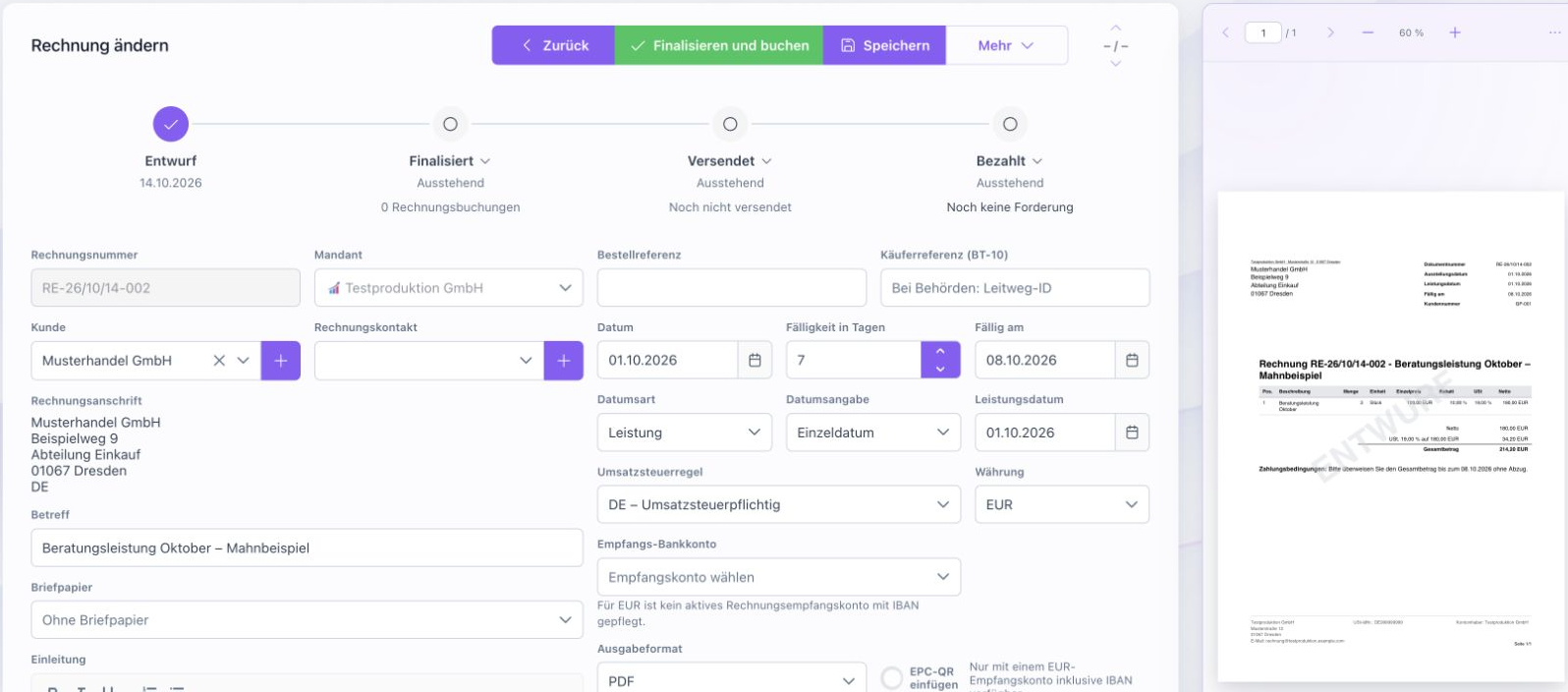
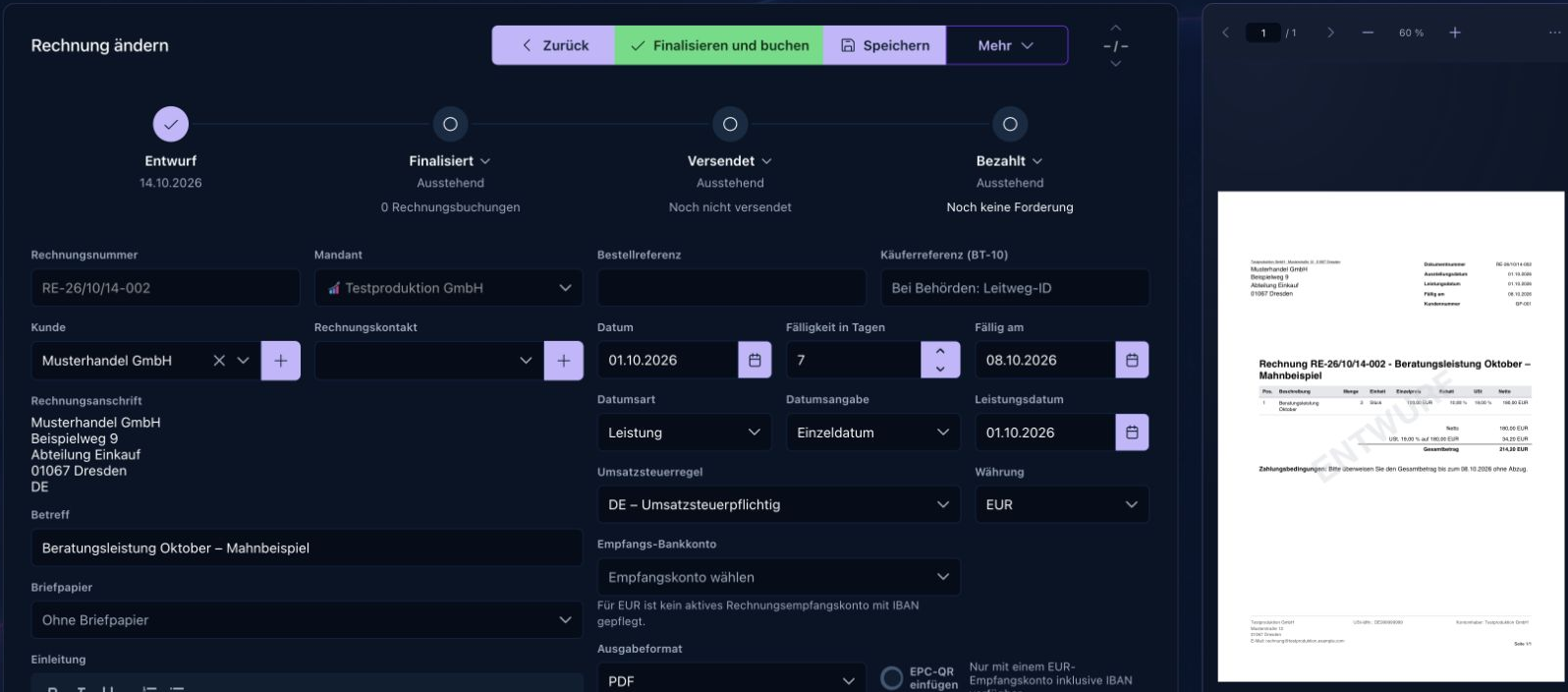
First look at the fictional companies on the demo page. In a personal test instance, you can then use your own documents, invoices and bank data. A suitable test covers the complete route: file a document, process a bank transaction, check a posting and view a report.
Frequently asked questions
Your questions about switching to a GmbH or UG
At what profit level is a GmbH worthwhile for a freelancer?
A general profit threshold is not a reliable basis for a decision. Compare your personal cash needs, funds retained in the business, ongoing costs and personal taxation. Have a comparison prepared for your specific scenarios.2
Can I incorporate a GmbH on my own?
Yes. The GmbH Act allows incorporation by one or more people. Even as the sole shareholder, plan for capital, management and the company's ongoing tasks.
Source:GmbHG §§ 1, 2, 7 and 11: Incorporation and registration
Does a UG have fewer bookkeeping obligations than a GmbH?
The UG makes getting started easier through different capital rules. It also needs its own bookkeeping with a balance sheet and income statement. Its actual size and circumstances determine further year-end requirements and possible reliefs.
Sourcen:§ 5a GmbHG: Unternehmergesellschaft (UG)§ 242 HGB: Obligation to prepare financial statements§ 264 HGB: Annual financial statements of a corporation
Do I remain a liberal professional for tax purposes with my GmbH?
Your personal work as a liberal professional and the corporation's activity must be classified separately. A corporation's activity is generally treated as a business operation for trade tax purposes. Include this change in your tax comparison.
Sourcen:§ 18 EStG: Income from self-employed professional activities§ 2 GewStG: Subject of trade tax
Does incorporation itself transfer my existing business?
Plan both as separate tasks. Transferring contracts, assets and liabilities requires clarification of the appropriate method, valuation and tax consequences. Incorporation alone does not make a transfer tax-neutral.4
Do I need a tax adviser for every ongoing posting?
You can organise ongoing document and posting work yourself. Agree with your adviser which decisions and checks you delegate. Management remains responsible for proper bookkeeping.1
Source:§ 41 GmbHG: Bookkeeping
Do I already need to be able to receive e-invoices in 2026?
Yes, the receipt requirement has applied to the domestic business sector since 2025. The transitional periods concern issuance. An email inbox may suffice for receipt; also organise unaltered storage of the structured original file.5
Does Accounting Scalable also suit my single GmbH?
Yes. You can run a single GmbH or UG and later add further companies in the same instance. Accounting and annual financial statements are included in Solo, Holding and Serial Entrepreneur. The pricing page shows allowances and plan differences.6
For reading and citation
Official sources and editorial status
This guide was created for Accounting Scalable and editorially updated on 5 November 2026 editorially updated. The primary sources below have their own access dates; electronic-invoicing information was last checked on 2 November 2026. The decision matrix and steps are our editorial presentation.1
- § 18 EStG: Income from self-employed professional activities
Tax classification of liberal professional activities
Retrieved on - GmbHG §§ 1, 2, 7 and 11: Incorporation and registration
Number of founders, notarisation, commercial register and acting before registration
Retrieved on - GmbHG section 5: share capital
Minimum share capital of a GmbH
Retrieved on - § 5a GmbHG: Unternehmergesellschaft (UG)
Payment, contributions in kind and the UG reserve
Retrieved on - § 13 GmbHG: Legal person and commercial company
The company's own rights and obligations; company assets
Retrieved on - § 1 KStG: Unlimited corporation tax liability
Corporation tax liability of domestic corporations
Retrieved on - § 2 GewStG: Subject of trade tax
Commercial classification of corporations' activities
Retrieved on - § 20 EStG: Income from capital assets
Treatment of profit distributions
Retrieved on - § 238 HGB: Bookkeeping obligation
Traceable recording of business transactions
Retrieved on - § 242 HGB: Obligation to prepare financial statements
Opening balance sheet, balance sheet and income statement
Retrieved on - § 264 HGB: Annual financial statements of a corporation
Additional year-end requirements and size-dependent reliefs
Retrieved on - § 41 GmbHG: Bookkeeping
Management's responsibility for bookkeeping
Retrieved on - § 5b EStG: Electronic submission of balance sheets
Electronic balance sheet submission for tax purposes
Retrieved on - HGB section 325: publication
Electronic disclosure to the Unternehmensregister
Retrieved on - § 20 UmwStG 2006: Contribution to a corporation
Valuation and conditions for transferring a business
Retrieved on - BMF: Questions and answers on e-invoicing
Structured invoices, receipt and issuance; BMF FAQ dated 29 October 2026, current as of October 2026
Retrieved on
Notes and requirements
This article provides general information and does not constitute individual tax advice. You remain responsible for reviewing your bookkeeping, annual financial statements and tax returns. This editorial guide provides general orientation for business owners. It is not individual tax, legal or incorporation advice. Have the choice of legal form, contracts and tax arrangements reviewed for your circumstances. Accounting Scalable offers its software exclusively B2B.
The decision matrix is an editorial working aid, not a tax calculation or individual recommendation. Results and tax burdens depend, among other things, on your personal circumstances, remuneration, distributions, location, financing and the rules for the relevant period. No tax savings are promised.
Limited liability, share capital and liquidity must be assessed separately. Before entry in the commercial register, people acting on the company's behalf may be personally liable (§ 11 GmbHG); a company does not generally eliminate personal obligations. Contributions in kind are prohibited when incorporating a UG (§ 5a GmbHG). Share capital is not a flat allowance for incorporation costs.
New incorporation, transfer of individual items and a contribution under restructuring tax law are different transactions. Valuation, requirements, necessary consents and timing must be clarified individually. This guide promises no automatic or tax-neutral conversion.
The e-invoicing information was checked on 2 November 2026 against the BMF FAQ dated 29 October 2026, current as of October 2026. Exceptions, for example for certain transactions and small businesses under the Kleinunternehmer rules, and special B2G rules must be checked separately. For other electronic invoices during the transitional period, the recipient's consent must be considered. The obligation to issue invoices is distinct from receiving and retaining them. BMF FAQ on e-invoicing
SKR03/SKR04 compatible means extensible templates with a selection of common accounts. Bank data depends on the bank and provider. E-invoice profiles and tax submissions have the requirements explained on the feature pages. Registry export provides XML with XBRL content for the intended GmbH/UG cases; you upload it and submit further required documents manually. Software does not replace accounting and tax review. Features and detailed notes
MCP requires authorised agent access and a compatible client. Access to email, folders or portals comes from the assistant's own tools. Final review, finalising entries and tax returns including submission remain with you. The specific access and file limits are on the MCP page. MCP capabilities and requirements