 Accounting Scalable
Guide · As of
The first postings for your GmbH or UG: five common cases
For every document, first check the company, facts, period and existing posting status. Only then record the appropriate transaction and link document and payment without posting it twice. The five fictional cases illustrate this review sequence; they are not a universal account assignment template for every incorporation stage.1
Who is it for? Managing directors and people doing their own GmbH/UG bookkeeping, with basic double-entry bookkeeping knowledge and their own complete documentation.3
Five cases, one traceable review sequence2
The following cases are explicitly fictional. Start with the document and the facts, search for existing postings and clarify the accounting and tax treatment. Only then create a transaction or match a payment.
The limited example of a 12 euro bank fee shows a specific journal entry under explicitly stated assumptions. It is not a universally suitable account assignment: accounts, tax rates and amounts depend on your actual circumstances, documents and the chosen accounting and tax treatment. You remain responsible for your own checks and decisions.
1. Payment into the company's bank account
A fictional GmbH receives a documented shareholder contribution into its business bank account.
Required documents: company/contribution documents, bank evidence, existing opening balances.
Review questions: is this actually a capital contribution owed, or, for example, a separate financing transaction? Which part has already been included in the opening balances?
Verifiable result: the contribution and capital balance are traceable; the bank receipt is recorded neither as sales revenue nor twice.
Common mistake: treating every incoming shareholder payment as sales or share capital without documents.
- Select the correct company/year.
- Review the bank transaction and evidence of the contribution together.
- Record the transaction with its treatment clarified, or match an existing transaction.
- Check account/document links and the resulting records.
Basics: HGB §272: Equity · GmbHG §7: Contributions before registration
2. Incorporation or notary invoice
A notary invoice relates to the incorporation of the fictional company; the instruction and documented agreement to bear costs are supplied together.
Required documents: original invoice, order/application, company documents and any agreement to bear costs, proof of payment.
Review questions: who is the actual client/person liable for costs? Which stage, recipient and documented assumption of costs apply? Is the proposed treatment, including input VAT, justified in this specific case?
Verifiable result: the document is assigned to the company it demonstrably belongs to or to the case requiring separate clarification.
Common mistake: treating an invoice ordered privately or assumed from someone else as an undisputed GmbH expense with input VAT solely because it was paid from the company account.
- Check the invoice in the correct company's document storage.
- Record unresolved questions about the liable party/assumption of costs before posting.
- Record only after treatment has been clarified; link the document and payment.
- Check recipient, period and link.
Basics: GNotKG §29: Liability for notary costs · UStG §15: Input VAT deduction
3. Worked example: a 12 euro bank fee
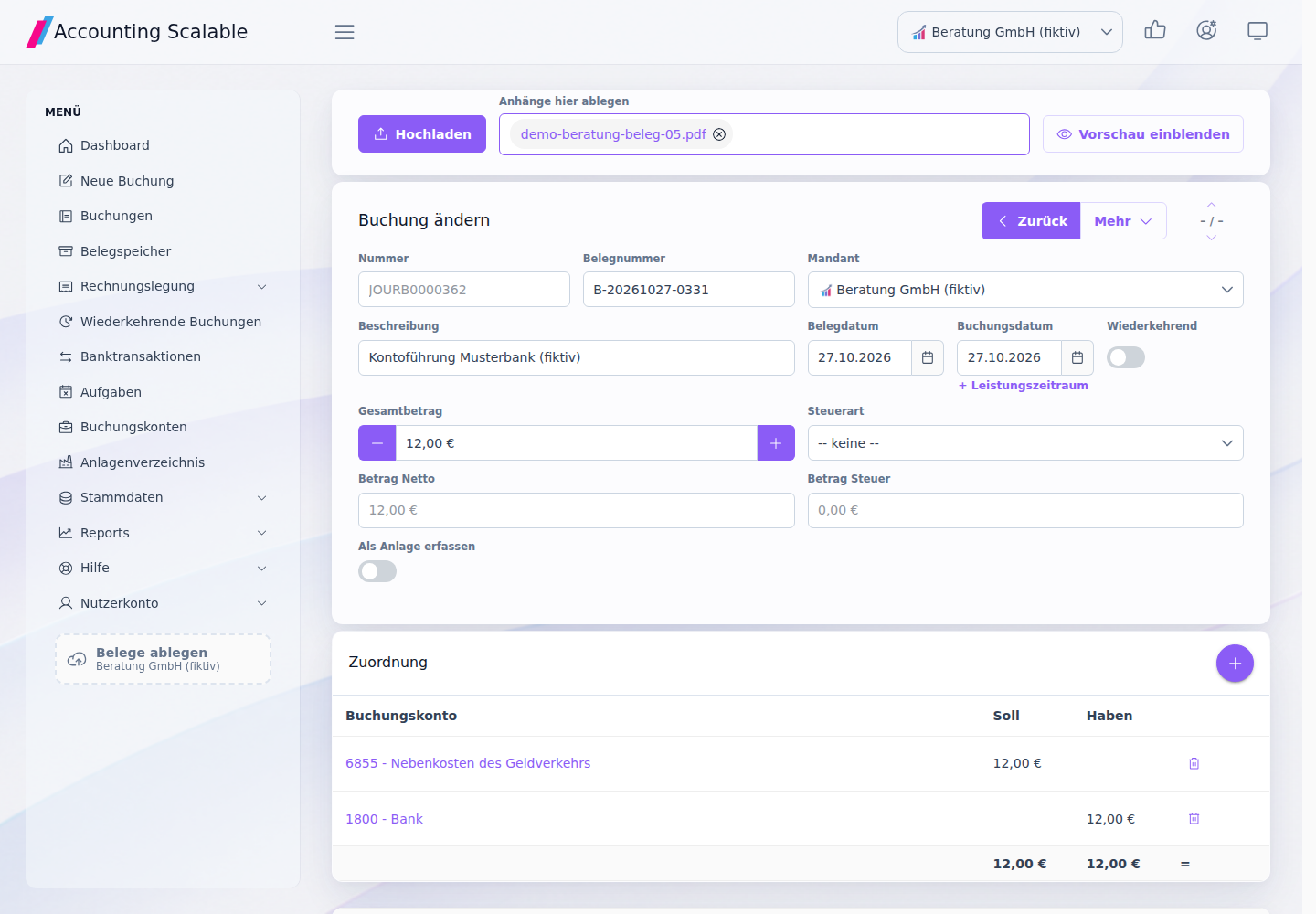
Starting point: Beratung GmbH (fictional) pays a bank account fee of 12.00 euros from its business account on 27 October 2026. For this limited example, we assume that the statement relates entirely to this company and period, shows no VAT, and the same transaction has not already been posted.
We use the accounts shown in the app view from a chart of accounts based on SKR04: 6855 ‘Bank charges’ and 1800 ‘Bank’. Account numbers, labels and tax treatment must match your actual configured chart of accounts and the supporting document.
Your decision: post the confirmed expense directly against the bank. This example neither settles an already posted purchase invoice nor claims input VAT. Other bank services may require different treatment.
Calculation and effect: debit 12.00 euros = credit 12.00 euros. The expense increases by 12.00 euros, the bank balance falls by 12.00 euros; profit from this individual transaction decreases by 12.00 euros. The overall income statement may contain other postings.
Verifiable result: the app view shows the fictional transaction with both accounts and the amount. After entry, compare the date, company, document link and both sides. An existing posting is checked, not created again.
- Open 2026 and the document dated 27 October 2026 in the correct company.
- Reconcile the statement and bank debit for 12.00 euros; search for existing entries.
- Only under the stated assumptions, post 12.00 euros to the debit of 6855 and the credit of 1800.
- Check the date, amount, accounts and document link; then reconcile the actual bank balance. If the document or chart of accounts differs, clarify the treatment first.
On narrow screens, you can scroll the table sideways. With a keyboard, focus the table first.
| Page | Account in the example | Amount |
|---|---|---|
| Debit | 6855 Bank charges | 12.00 EUR |
| Credit | 1800 Bank | 12.00 EUR |
Basics: UStG §4: VAT exemptions · UStG §9: Option to tax · HGB §252: Valuation principles
4. First purchase of a fixed asset
The fictional GmbH buys a device for business use.
Required documents: purchase invoice, delivery/start of use, proof of payment.
Review questions: is the item intended for long-term business use? Which acquisition costs, use and valuation decisions are relevant? Do the company, document and chosen treatment fit together?
Verifiable result: a supported acquisition/fixed asset record with traceable parameters.
Common mistake: automatically depreciating every device in the same way or adopting an unconfirmed low-value asset (GWG) threshold from a template.
- Check the purchase document and record the appropriate transaction.
- Check master data and the document link in the supported fixed asset workflow.
- Assess the depreciation preview only on the basis of confirmed parameters.
Basics: HGB §247: Fixed assets · HGB §253: Valuation and depreciation · UStG §15: Input VAT deduction
5. First customer invoice and payment
The fictional GmbH has invoiced a service; a payment then arrives.
Required documents: invoice, evidence of service/contract, bank payment.
Review questions: are issuer, customer, service and period correct? Has the invoice already been recorded? Does the incoming payment belong to this exact transaction?
Verifiable result: payment and invoice are traceably linked; the transaction has not blindly been recorded a second time as revenue.
Common mistake: additionally posting the bank receipt as a new sales invoice or a second sale.
- Check the sales document and invoice status.
- Open the existing invoice/posting link.
- Match the corresponding bank payment and check the open status.
- Trace the invoice, posting and payment together.
Basics: UStG §14: Invoice and audit trail · HGB §252: Valuation principles
What you check together at the end
Open the document, posting and, where applicable, bank transaction side by side or one after another in the correct tenant. If the transaction is already recorded, check its link instead of creating a second equivalent transaction.
Record unresolved questions in the working status. For an unclear invoice recipient or an undocumented assumption of costs, a visibly open transaction is the correct result; an unsupported posting would not be progress.
On narrow screens, you can scroll the table sideways. With a keyboard, focus the table first.
| Question | Review step | Result |
|---|---|---|
| Correct company? | Compare issuer/recipient details and documents | Documented classification |
| Transaction already exists? | Find the invoice, posting and payment | No blind duplicate entry |
| Treatment clarified? | Check account/tax decisions and the period | Traceable entry or open question |
| Complete link? | Check the original, posting and bank matching | Shared review path |
Sources and information date
- HGB §272: Equity
Publisher: Bundesministerium der Justiz / Bundesamt für Justiz. Legal/information status: 3 November 2026. Retrieval / comparison: 2026-11-03.
- GmbHG §7: Contributions before registration
Publisher: Bundesministerium der Justiz / Bundesamt für Justiz. Legal/information status: 3 November 2026. Retrieval / comparison: 2026-11-03.
- GNotKG §29: Liability for notary costs
Publisher: Bundesministerium der Justiz / Bundesamt für Justiz. Legal/information status: 3 November 2026. Retrieval / comparison: 2026-11-03.
- HGB §247: Fixed assets
Publisher: Bundesministerium der Justiz / Bundesamt für Justiz. Legal/information status: 3 November 2026. Retrieval / comparison: 2026-11-03.
- HGB §253: Valuation and depreciation
Publisher: Bundesministerium der Justiz / Bundesamt für Justiz. Legal/information status: 3 November 2026. Retrieval / comparison: 2026-11-03.
- HGB §252: Valuation principles
Publisher: Bundesministerium der Justiz / Bundesamt für Justiz. Legal/information status: 3 November 2026. Retrieval / comparison: 2026-11-03.
- UStG §15: Input VAT deduction
Publisher: Bundesministerium der Justiz / Bundesamt für Justiz. Legal/information status: 3 November 2026. Retrieval / comparison: 2026-11-03.
- UStG §4: VAT exemptions
Publisher: Bundesministerium der Justiz / Bundesamt für Justiz. Legal/information status: 3 November 2026. Retrieval / comparison: 2026-11-03.
- UStG §9: Option to tax
Publisher: Bundesministerium der Justiz / Bundesamt für Justiz. Legal/information status: 3 November 2026. Retrieval / comparison: 2026-11-03.
- UStG §14: Invoice and audit trail
Publisher: Bundesministerium der Justiz / Bundesamt für Justiz. Legal/information status: 3 November 2026. Retrieval / comparison: 2026-11-03.
See the right workflow for yourself.
Start with synthetic examples in the read-only demo. Then check your own test records in your personal instance.
Notes and requirements
This article provides general information and does not constitute individual tax advice. You remain responsible for reviewing your bookkeeping, annual financial statements and tax returns. This general working guide does not replace individual tax or legal advice. You review and take responsibility for your information and approvals. You can seek targeted advice on individual unresolved technical questions.
All explicitly fictional cases and app views use test data. They are not customer reports, evidence of time or cost savings, or universal templates for tax account assignment.
The software supports the app scope described in each case. Year-end closing, tax returns/E-Bilanz and registry filing are separate tasks; supported years, formats, instance configuration and your own approvals determine the usable route.